
Could Southeast Asia become carbon neutral by 2050, even as energy demand increases? The region is growing quickly and still relies heavily on fossil fuels.
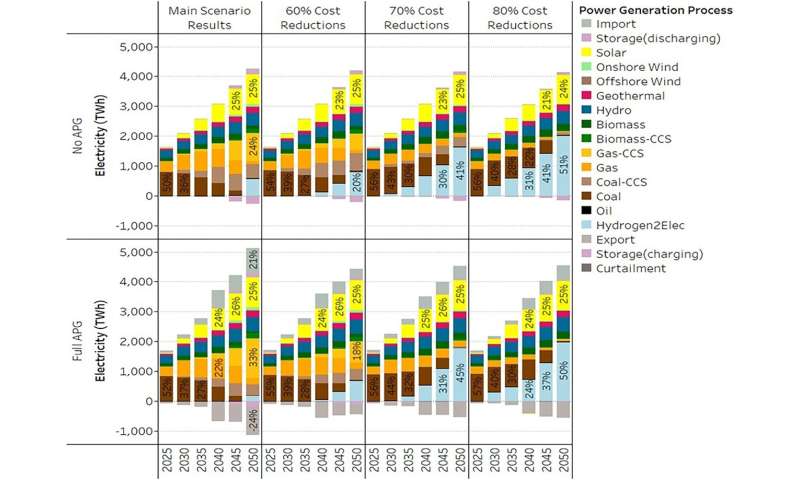
A modeling study by Bin Su and colleagues, published inPNAS Nexus, provides an energy system optimization model with pathways to net-zero emissions by 2050 for the electricity and hydrogen sectors in members of the Association of Southeast Asian Nations (ASEAN): Indonesia, Malaysia, Philippines, Singapore, Thailand, Brunei, Vietnam, Lao PDR, Myanmar, and Cambodia. The model simulates energy production and demand with hourly resolution and includes cross-border electricity transmission through a proposed ASEAN Power Grid.
The authors describe two possible pathways to net-zero: the region can accelerate investment in renewables, especially solar and wind, and battery storage—or it can expand investment in carbon capture and storage (CCS) and hydrogen fuel. Hydrogen imports help achieve net-zero in scenarios where there are limited resources to develop renewable energy sources or improve grid connectivity.
Technologies to create hydrogen (H2) gas, including solar-to-H2, wind-to-H2, gas-to-H2 with CCS, coal-to-H2 with CCS, and methane pyrolysis-to-H2 would have to become much cheaper over time for this pathway to function.
According to the authors, the findings offer policymakers an evidence-based foundation for assessing technological trade-offs as they work toward ASEAN's net-zero goals.
More information: Sheng Zhong et al, Charting net-zero pathways for ASEAN's energy sector, PNAS Nexus (2026). DOI: 10.1093/pnasnexus/pgaf389
Provided by PNAS Nexus
Citation: Energy system optimization model developed for pathways to net-zero greenhouse gas emissions for Southeast Asia (2026, January 6) retrieved 7 January 2026 from https://techxplore.com/news/2026-01-energy-optimization-pathways-net-greenhouse.html
This document is subject to copyright. Apart from any fair dealing for the purpose of private study or research, no part may be reproduced without the written permission. The content is provided for information purposes only.