
A new study co-led by the University of Oxford has found that global aviation emissions could be reduced by 50–75% through combining three strategies to boost efficiency: flying only the most fuel-efficient aircraft, switching to all-economy layouts, and increasing passenger loads.
Crucially, the study shows that around an 11% reduction in global aviation emissions is achievable immediately, by using the most efficient aircraft that airlines already have more strategically on routes they already fly.
Key findings from the emissions analysis
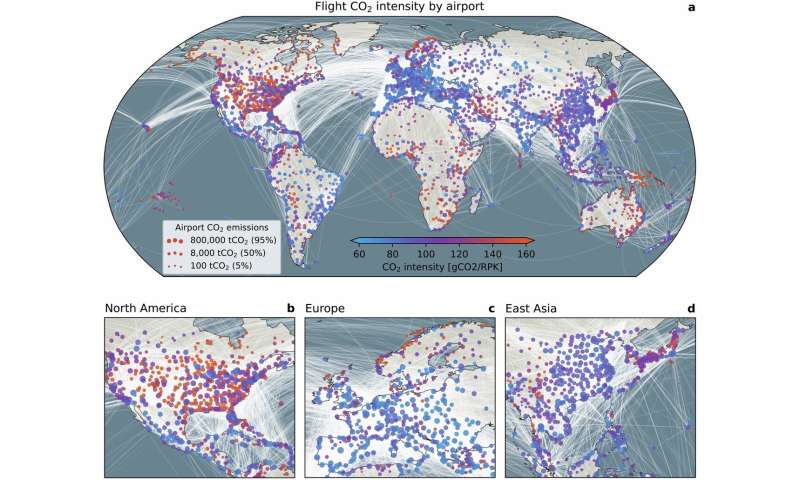
Published in Communications Earth & Environment, the researchers analyzed more than 27 million commercial flights in 2023, covering 26,000 city pairs and nearly 3.5 billion passengers. This revealed enormous variability in emissions efficiency, with some routes producing nearly 900 grams of CO₂ per kilometer for each paying passenger—almost 30 times higher than the most efficient, at around 30 grams of CO₂ per kilometer.
Co-author Dr. Milan Klöwer (Department of Physics, University of Oxford) said, "Our results clearly show that efficiency-focused policy could swiftly reduce aviation emissions by more than half, without reducing flight numbers or waiting for future fuels. These are tools that we can use right now."
Globally, average aviation emissions were 84.4 grams of CO₂ per kilometer for each paying passenger in 2023. But the study identifies three practical levers to reduce this figure: operating only the most fuel-efficient aircraft, removing premium-class seating to carry more passengers, and raising passenger loads to 95%.
Impact of aircraft models and seating
Aircraft model alone was found to make a significant difference, with emissions ranging from 60–360 grams of CO₂ per kilometer for each passenger. According to the analysis, replacing all aircraft with the most efficient models—the Boeing 787-9 (long-haul) and the Airbus A321neo (short and medium-haul)—would result in fuel savings of 25% to 28%.
Dr. Klöwer added, "While economically and practically unfeasible to replace all older aircraft short term, this analysis shows the potential more efficient aircraft have in comparison to other efficiency gains. Realistically, this would be a long-term transition—one that could be promoted by policies that reward efficiency, so that the most efficient aircraft are favored whenever replacement decisions are made."
Seating configurations also matter, since business and first-class seats are up to five times more CO₂-intense than economy-class seats. The researchers found that increasing passenger numbers to the maximum seating configuration for the most efficient aircraft would further reduce emissions by 22% to 57%.
Occupancy rates and potential reductions
In 2023, aircraft passenger occupancy ranged from 20% to 100%, with an average of 79%. According to the analysis, increasing average occupancy to 95% would further reduce emissions by 16%.
If these three measures were applied globally, the study estimates that emissions could be reduced by between 50% and 75%—though this full reduction would require systemic changes. Nevertheless, the analysis found that airlines could reduce emissions by around 11% right now by flying their most efficient aircraft on routes where they already operate.
Policy recommendations and regional findings
Lead author Professor Stefan Gössling (Linnaeus University) said, "Efficiency-based policies have a great potential to curb aviation emissions, and can be in airlines' own economic interest. But the reality is that many airlines continue to fly with old aircraft, low passenger occupancies, and growing proportions of premium-class seating."
The researchers suggest that efficiency improvements could be promoted using policy tools and market-based measures, such as emissions ratings for airlines, adjusted landing fees based on aircraft performance, and carbon intensity caps—drawing parallels to standards used in sectors like household appliances and vehicles.
The study was based on data from Airline Data, the International Civil Aviation Organization, and the International Air Transport Association. This showed that the regions with the most inefficient flights were Africa, Oceania, the Middle East, Central Asia, and North America. The regions with the most efficient flights were Brazil, India, and Southeast Asia.
The study also involved researchers from atmosfair providing data and the Munich University of Applied Sciences.
More information: Large carbon dioxide emissions avoidance potential in improved commercial air transport efficiency, Communications Earth & Environment (2026). DOI: 10.1038/s43247-025-03069-4
Citation: Global aviation emissions could be halved through maximizing efficiency gains (2026, January 7) retrieved 7 January 2026 from https://techxplore.com/news/2026-01-global-aviation-emissions-halved-maximizing.html
This document is subject to copyright. Apart from any fair dealing for the purpose of private study or research, no part may be reproduced without the written permission. The content is provided for information purposes only.