
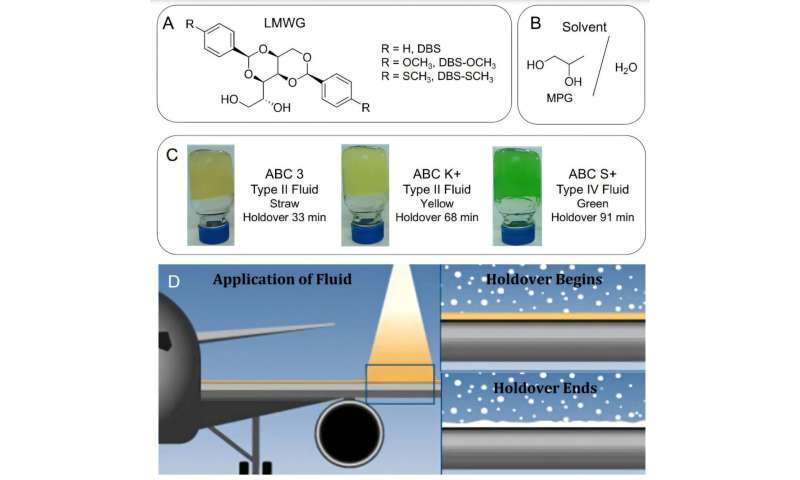
Tiny molecules already used to thicken everyday products like lotions and adhesives may soon help keep aircraft safe in icy conditions. These molecules, known as low-molecular-weight gelators (LMWGs), can self-assemble into soft, gel-like structures and have long been used in industrial formulations.
In a study published in Langmuir, researchers report that adding just small amounts of these molecules can significantly improve the performance of aircraft anti-icing fluids.
The team modified commercial deicing and anti-icing fluids—which already contain polymers for protective coating—by incorporating LMWG molecules to produce a hybrid gel formulation. They tested three variants of a gelator, known as DBS (1,3:2,4-dibenzylidenesorbitol), at varying levels of aviation-grade agents used to remove existing ice and prevent new ice formation on aircraft surfaces during ground operations.
They found that adding just 0.25 grams of the DBS gelator nearly doubled the time a plane can safely sit on the runway before ice starts to form on its surface.
Anti-icing and deicing solutions
The aviation industry uses different grades of fluids to tackle ice-related challenges, commonly classified as Types I through IV. These fluids serve two distinct purposes: deicing and anti-icing.
Deicing removes ice that has already formed on aircraft surfaces. Type I fluids, which are thin, low-viscosity mixtures of glycol and water designed to melt and wash away existing ice, handle the task of deicing.

Anti-icing, on the other hand, takes a preventative approach for aircraft waiting on the ground. Types II, III, and IV fluids create a protective film that stops ice from forming in the first place.
The duration between when anti-icing is sprayed on the aircraft to the point where it loses its fluidity and ability to prevent ice formation is known as the holdover time. The higher the holdover time, the better, as a longer window means the aircraft remains protected for longer in cold weather, giving pilots and flight crews greater flexibility and cutting down on repeated anti-icing applications.
Traditional anti-icing agents rely on polymers to form protective films, but they are often expensive and ineffective in providing longer holdover times.
Previous studies have found that LMWGs could improve simple deicing fluids, but their compatibility with complex, polymer-containing anti-icing formulations remained unexplored until now. So, the researchers of this study decided to explore this further.
The team mixed 0.25 grams per liter of LMWGs into three commercial anti-icing fluids—ABC 3, ABC K+, and ABC S+. The resulting hybrid gel was tested in a freezing chamber at −5 °C, where a fine mist of water was sprayed onto the samples to measure their holdover time.
The modified fluid increased holdover times for certain formulations, extending them from roughly 60–70 minutes to as much as 100–120 minutes. The team simulated shear forces experienced by aircraft in flight and found that the gel remained thick at rest but broke down under strain.
The researchers suggest that these inexpensive gelators could be a promising option for real-world use in aircraft anti-icing systems, as they are easy to blend into existing fluids and deliver substantial performance gains.
Written for you by our author Sanjukta Mondal, edited by Sadie Harley, and fact-checked and reviewed by Andrew Zinin—this article is the result of careful human work. We rely on readers like you to keep independent science journalism alive. If this reporting matters to you, please consider a donation (especially monthly). You'll get an ad-free account as a thank-you.
More information: Nicole K. McLeod et al, Self-Assembly of Supramolecular Gels in Complex Anti-icing Fluids to Create Multicomponent Materials with Enhanced Performance, Langmuir (2025). DOI: 10.1021/acs.langmuir.5c05067
© 2025 Science X Network
Citation: Low-cost gelators nearly double the performance of aircraft anti-icing fluids, finds new study (2025, December 31) retrieved 4 January 2026 from https://techxplore.com/news/2025-12-gelators-aircraft-anti-icing-fluids.html
This document is subject to copyright. Apart from any fair dealing for the purpose of private study or research, no part may be reproduced without the written permission. The content is provided for information purposes only.