
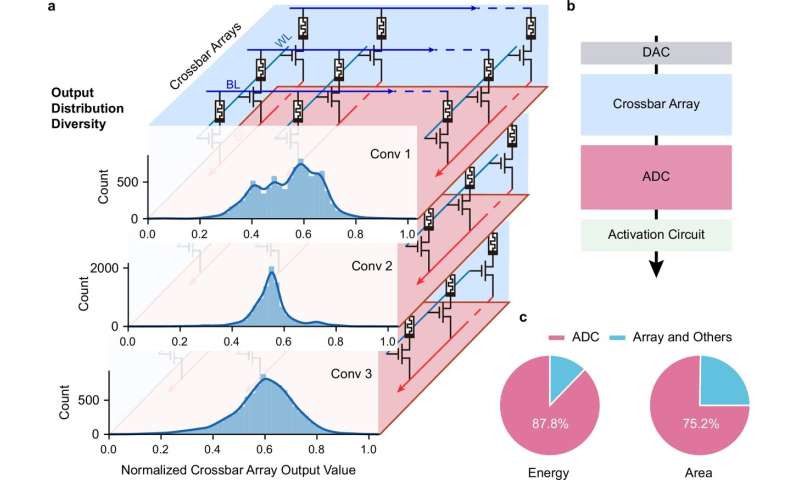
A cross-institutional team led by researchers from the Department of Electrical and Electronic Engineering (EEE), under the Faculty of Engineering at The University of Hong Kong (HKU), have achieved a major breakthrough in the field of artificial intelligence (AI) hardware by developing a new type of analog-to-digital converter (ADC) that uses innovative memristor technology. The work is published in Nature Communications.
Challenges with conventional AI hardware
Conventional AI accelerators face challenges because the essential components that convert analog signals into digital form are often bulky and power-consuming. Led by Professor Ngai Wong, Professor Can Li and Dr. Zhengwu Liu of HKU EEE, in collaboration with researchers from Xidian University and the Hong Kong University of Science and Technology, the cross-disciplinary research team developed a new type of ADC that uses innovative memristor technology. This new converter can process signals more efficiently and accurately, paving the way for faster, more energy-efficient AI chips.
Adaptive system and efficiency gains
The research team created an adaptive system that automatically adjusts its settings based on the data it receives, i.e., dynamically fine-tuning how signals are converted. This results in a 15.1× improvement in energy efficiency and a 12.9× reduction in circuit area compared with state-of-the-art solutions.

Beyond hardware performance, this new adaptive ADC not only improves hardware performance but also maintains high accuracy when running neural network tasks across various types of AI models. When integrated into compute-in-memory (CIM) systems, the ADC further reduces overall energy consumption and chip size by more than 57% and 30%, respectively.
This breakthrough represents a significant milestone in bridging the gap between algorithmic intelligence and hardware adaptability, showcasing how memristive computing can revolutionize the design of next-generation AI chips. It also highlights HKU EEE's leadership in cross-domain research that unites device physics, circuit design, and machine learning systems.
More information: Haiqiao Hong et al, Memristor-based adaptive analog-to-digital conversion for efficient and accurate compute-in-memory, Nature Communications (2025). DOI: 10.1038/s41467-025-65233-w
Citation: New memristor-based converter boosts energy efficiency in AI hardware (2025, December 17) retrieved 5 January 2026 from https://techxplore.com/news/2025-12-memristor-based-boosts-energy-efficiency.html
This document is subject to copyright. Apart from any fair dealing for the purpose of private study or research, no part may be reproduced without the written permission. The content is provided for information purposes only.